

No. 1Public Benefit Guides · for boards deciding: continue, change form, or wind down
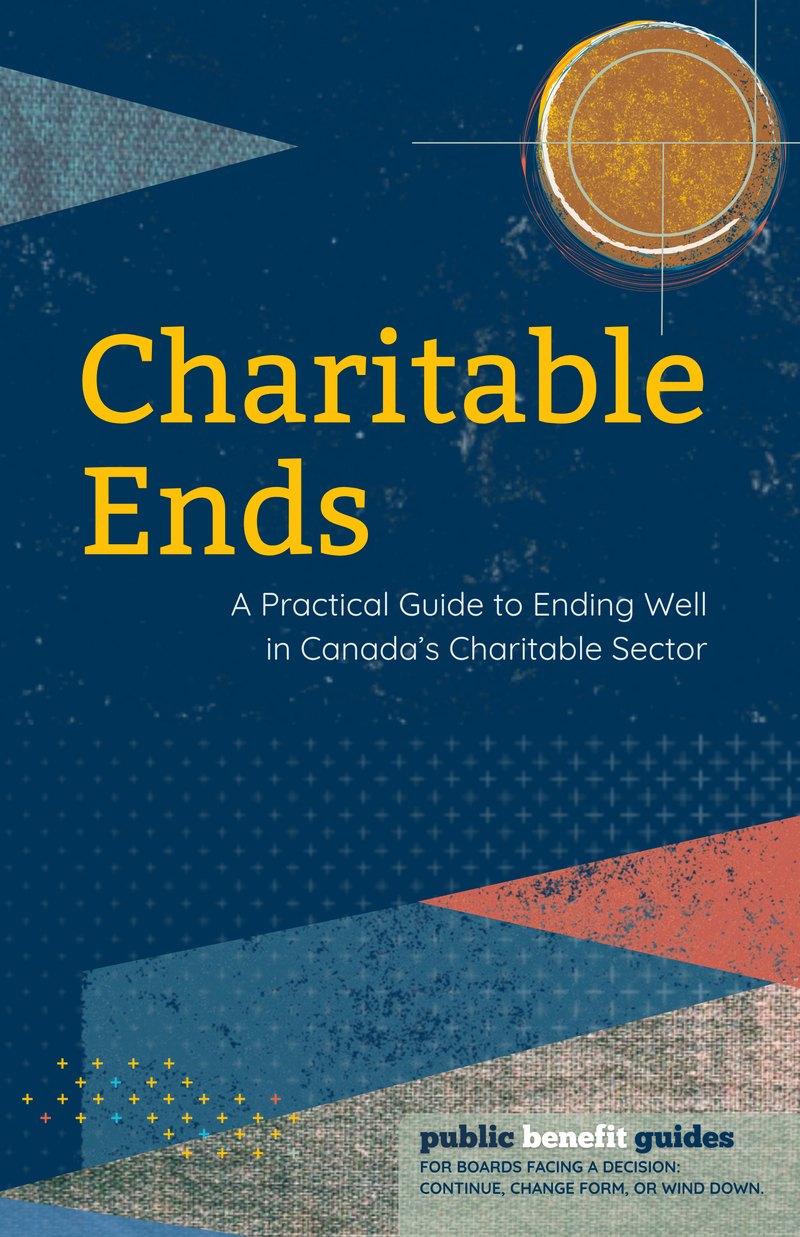
Charitable Ends
A Practical Guide to Ending Well in Canada's Charitable Sector
Every organization ends. Some are absorbed, some hand their work to better hands, some run out of road, and a few finish what they set out to do. What almost none of them have is a book that says how, in the Canadian context, in plain language, from the first hard conversation to the last filing. This is that book.
Thirty-one chapters on the whole of an ending: what a board's duties actually are when the question arrives, who has to agree, what the staff are owed and when, where the assets may lawfully go, what the regulators need and in what order, and what has to be kept and by whom after the doors close. Written for the board member who has to decide and the coordinator who has to carry it out.
Printed from publicbenefit.ca/charitable-ends · info@publicbenefit.ca · 519-589-9084
Every organization ends.
Some are absorbed, some hand their work to better hands, some run out of road, and a few finish what they set out to do. What almost none of them have is a book that says how, in the Canadian context, in plain language, from the first hard conversation to the last filing. This is that book.
Thirty-one chapters and three hundred and six pages on the whole of an ending: what a board's duties actually are when the question arrives, who has to agree, what the staff are owed and when, where the assets may lawfully go, what the regulators need and in what order, and what has to be kept and by whom after the doors close. It covers closing, transferring, merging, and amalgamating, federally and across the provinces and territories, and it treats insolvency as its own road rather than a footnote.
It is written for two people at once. The board member who has to decide, and the coordinator who has to carry it out. Both are usually volunteers. Both are usually reading it at night.
Who it is for
- You are on a board and the question has been raised, or has not been raised and should be.
- You are the executive director who can see the runway ending and needs the board to see it too.
- You are the accountant, the lawyer, or the retired administrator every board in town calls first, and you do one of these files a year as a kindness.
- You are none of these and you simply want to know how public good is wound up in this country, and by whom.
What it is not
No villain. A book about endings could easily find one, and the ones on offer are always the same: the founder who held on, the board that did not look, the funder who left. Blaming any of them ends the same way, with a tired person reading that they should have done better. The people who stayed are the reason there is anything left to wind up carefully.
The Guide takes the weight off the person and puts it back on the body that was supposed to carry it.

Where to get it.
Two formats, one book. Both carry the same 306 pages.
Every legal claim in it ties back to a research base of Canadian charity and not-for-profit law across fourteen jurisdictions. A charity lawyer reviewed the eight questions that carried the most risk, a retired insolvency trustee read the insolvency chapter, and its sources were confirmed through 24 August 2026. That date is printed in the book.
Paperback
CAD 34.95
Softcover, 306 pages, 5.5 by 8.5 inches. The one to buy if it is going to be passed around a board table, or written in.
ISBN 978-1-0679308-0-6
Buy the paperbackEbook
CAD 12.99
Reads on any Kindle, and on the free Kindle app for a phone, tablet, or computer.
ISBN 978-1-0679308-2-0
Buy the ebookYour bookshop and your library can both order the paperback. Give them the ISBN, 978-1-0679308-0-6, and they will find it. If you would rather not buy from Amazon, that is the way to do it.
Published by Public Benefit Canada Inc., Thunder Bay, Ontario, 1 September 2026. as a handout for a board table.
Charitable Ends explains the work in the Canadian context. It is not legal advice, and it does not replace it. Before a board acts on a specific question, the point it relies on should be confirmed against the current source, or with counsel.
The Coordinator's Toolkit
The Guide sets out the ground. The Toolkit is what a coordinator holds while doing the work: forty working tools covering the motions, the registers, the obligations, the filings, and the records, in a Canada edition, with editions for the provinces and territories built as they are needed.
It is not sold and it is not downloadable. A board passes a standing motion naming its coordinator, and the Toolkit goes to work inside that engagement, kept current for the year and reissued tool by tool when the law or a form changes. Where a board has already committed to winding down, the licence costs nothing.
Start a conversationA course, eventually
A book can carry what is true. Some of this work is learned another way: reading a set of financial statements and knowing which number is the one that matters, sitting through the meeting where the decision actually gets made, writing a motion that will still make sense to a regulator three years from now.
It is not built, and we would rather say so than choose a date to sound organized. What we are doing now is asking the people who would take it what they need to be able to do at the end of it. Four minutes, seven questions, and we read every answer. The first seats go to the people who helped shape it.
Put my name downFree
The Charitable Ends Primer.
The fastest way to put this in front of a board that has not read anything yet. It carries the critical path of the Guide and nothing else, and it is designed to be shared unaltered. It is being finished now. Leave an address and it arrives when it is ready.
One email, no form. Reply and we add you.